
🔗Matrix Live S13E15 - Website & Content Working Group updates
This episode, we're talking about the work of the Website & Content Working Group, and having a look behind the scenes in the production of This Week in Matrix itself. You can also read the news entry that is added during this video, down below!
Woah - a Matrix Live about This Week in Matrix, in This Week in Matrix... it feels like some kind of Inception scenario... 😎
🔗Dept of Status of Matrix 🌡️
🔗Governing Board (website)
The Governing Board is an advisory board to The Matrix.org Foundation and with elected representatives from all across the Matrix ecosystem.
HarHarLinks announces
Happy Friday, TWIM! It's been roundabout half a year since the last meeting and report from the Governing Board, though you might have been following this cycle's [election process]((@/foundation/governing-board-elections/2026/index.md) in May and June. I'm honored to follow in Greg's footsteps and announce the news this time as the Board's new chair, with a lot of support from our new vice-chair richvdh, and I am very grateful to Rich for taking the time to write up the report for you. 🙏 The Board gathered last week for its second meeting of the year for a comprehensive exchange of highlights in the Matrix world. As usual, you can find the comprehensive account in the blog post. We'd love to receive your feedback and questions - you can always find us at #governing-board-office:matrix.org.
If you'd like to learn more about how to get involved in the Foundation, the Governing Board, its members, structure, activities, Committees, Working Groups, or anything else, you can read a lot about this in the Foundation section right here on the matrix.org website. We're always excited about new ideas and initiatives - it's all of the ecosystem collaborating that really pushes Matrix forward.
Finally, in case you missed it until now, also watch the Foundation & Governing Board update from The Matrix Conference!
🔗Dept of Events and Talks 🗣️
🔗Stammtische (website)
HarHarLinks says
A Stammtisch ("regular's table") is a German meetup format where those with a shared interest meet regularly for discussion, exchange, and socialising.
Find more community organised events at matrix-community.events!
- 19 November (3rd Thursday of every month) 19:00 CET: #matrix-stammtisch:freiburg.social at Blauer Fuchs. Learn more.
- 19 November, 19:00 CET: #matrix-stammtisch:dresden.network at ro7. Learn more
Are you running a Matrix meetup? Add it to the list!
🔗FOSDEM 2027 (website)
Andy P says
FOSDEM will take place January 30-31, 2027 in Brussels.
A reminder that you have one more week to submit a proposal to the Decentralised Messaging Devroom! Check our blog post for the details. The deadline for submissions is 20 November.
More to come on FOSDEM very soon!
🔗Dept of Working Groups 💪
🔗Website & Content Working Group (website)
The Website and Content Working Group is responsible for the editorial and technical oversight of the main Matrix websites and social media channels.
MTRNord (they/them) reports
It has been 4 months since our last update and not only did we spend this time on lots of changes on the conference website but also we improved lots of other areas on the websites for you to enjoy!
🔗Overhauled Ecosystem Design
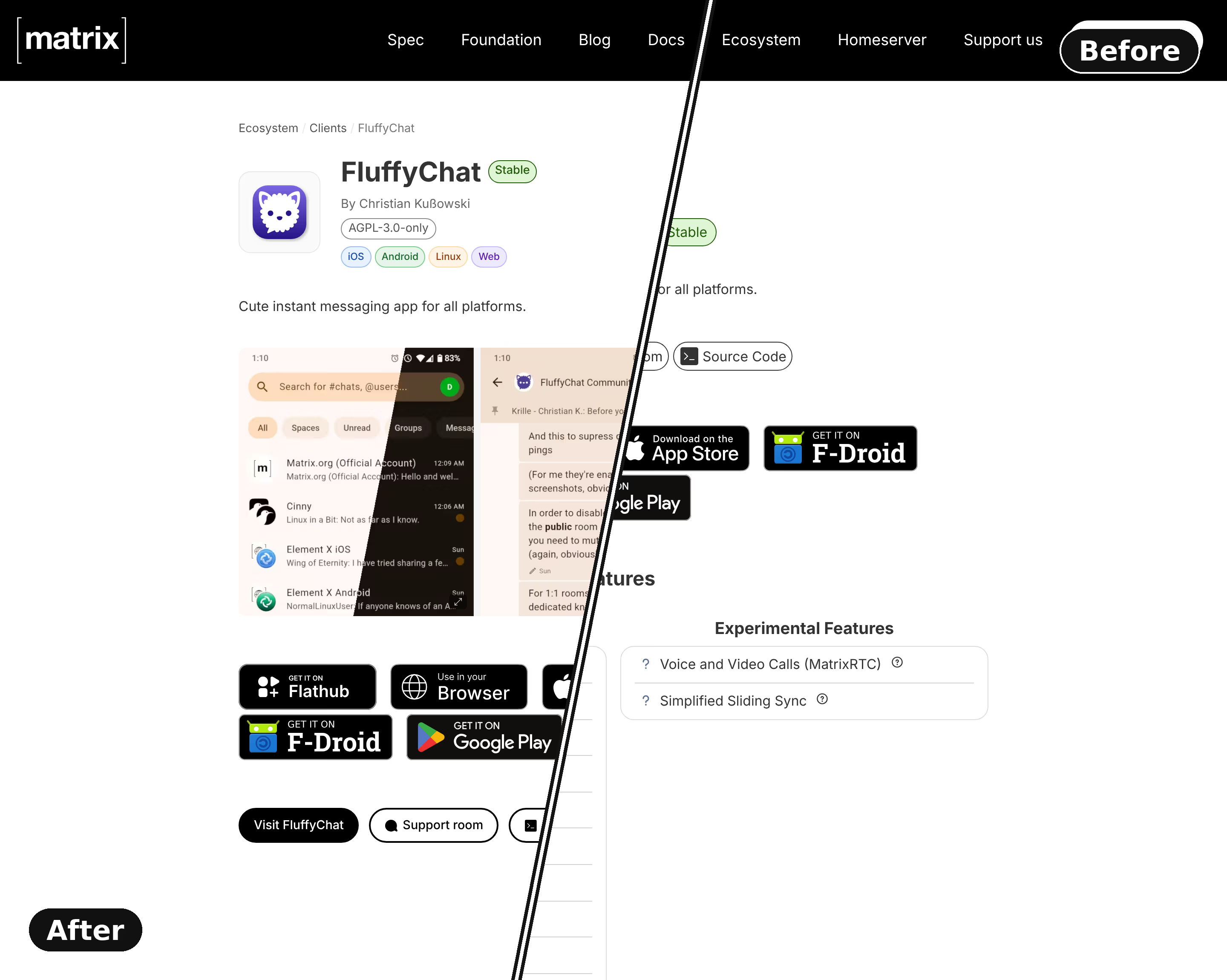
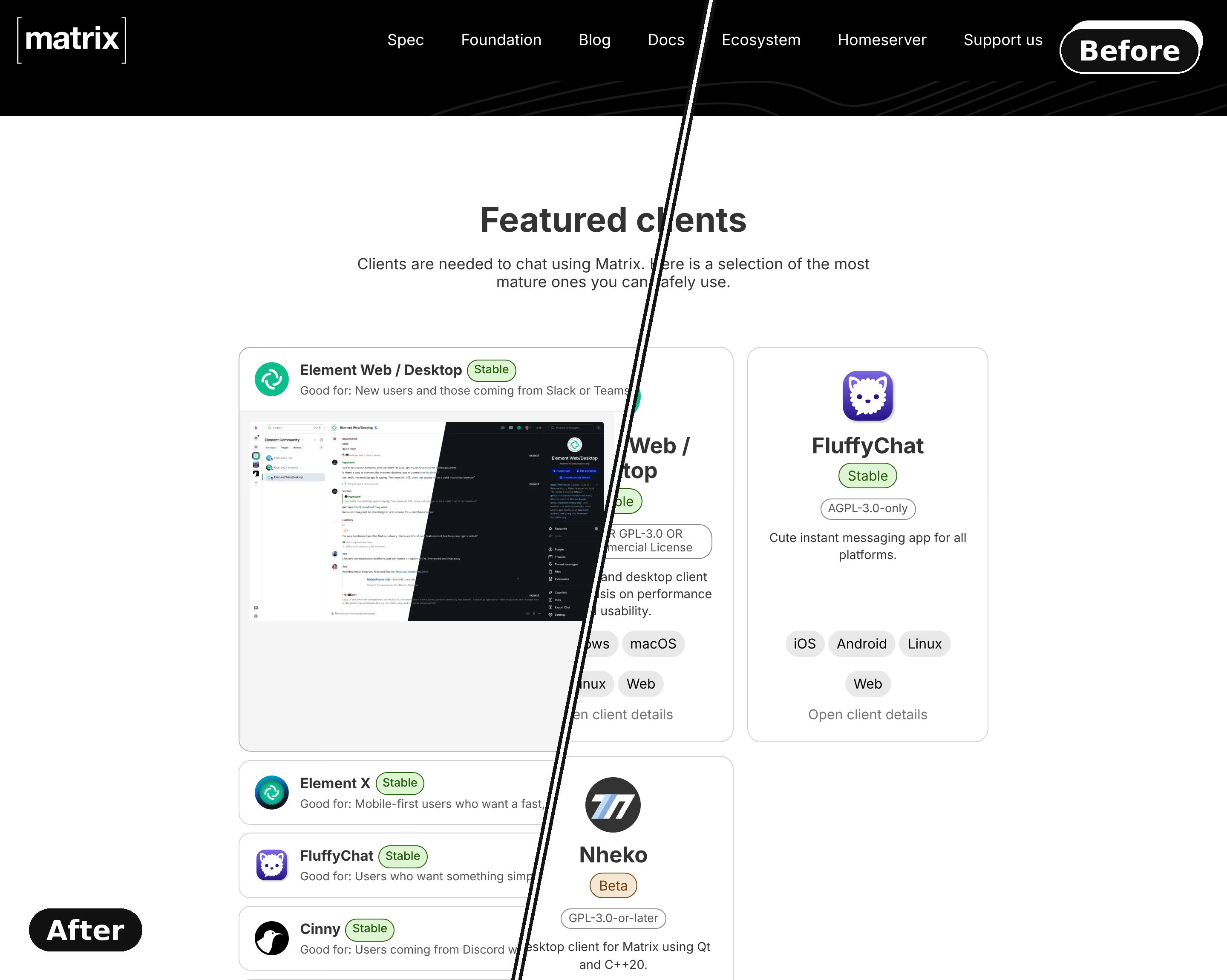
In the last update we already had major updates to the try-matrix page and also some improvements landed on the ecosystem pages. Since then we took this a step further and adapted the try-matrix design language also in the ecosystem. This means specifically for you:
- A new Featured clients section matching try-matrix
- Color coded pills 🌈
- Better support for SPDX license definitions
- Improved filtering (more colour!)
- A better overview of available features in clients - if you spot a ❔ icon and know about that client supporting that feature, click the link on the bottom of the page to let us know!
- Screenshots are back!
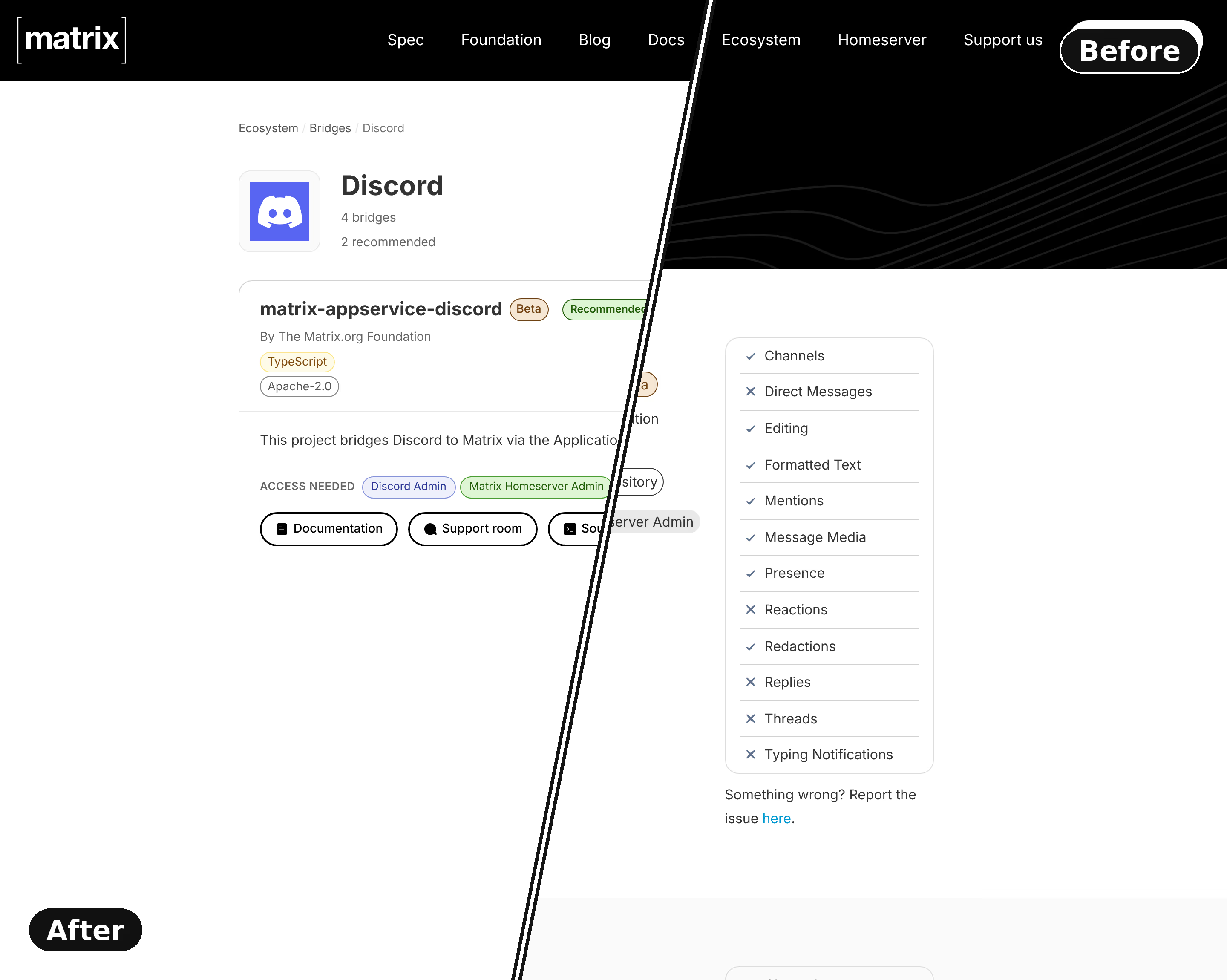
- Big improvements to the bridges
- Obsolete bridges are visually hidden
- Clearer feature support
- Better unified design across all ecosystem pages
- Breadcrumbs to more easily navigate subpages
🔗Other Changes to matrix.org
Apart from the big ecosystem update there have also be plenty of other changes.
Many thanks to all contributors helping us keep the ecosystem data up to date, including @clins1994, @Mizerd, @dfuchss, @SpiritCroc, @bones-was-here, @wigmarbled, and @subpop! Thanks to you, our ecosystem directory keeps growing and existing entries stay accurate. ❤️
We've also been doing regular maintenance to keep the Foundation, Governing Board, and Working Group information fresh, including adding two new Working Groups and updating information about existing ones.
On the technical side, we've done some housekeeping, including cleaning up our metadata templates, ensuring our matrix.to links follow the specification, and updating our content contribution guidelines with more information on how we handle media on the website.
We also introduced a new policy for ecosystem listings: projects now need to have been active and supported Matrix for at least three months before being considered for inclusion. This should help us ensure that projects listed in the ecosystem are actively maintained and have demonstrated support for Matrix.
🔗A New Native Schedule System for the Conference Website
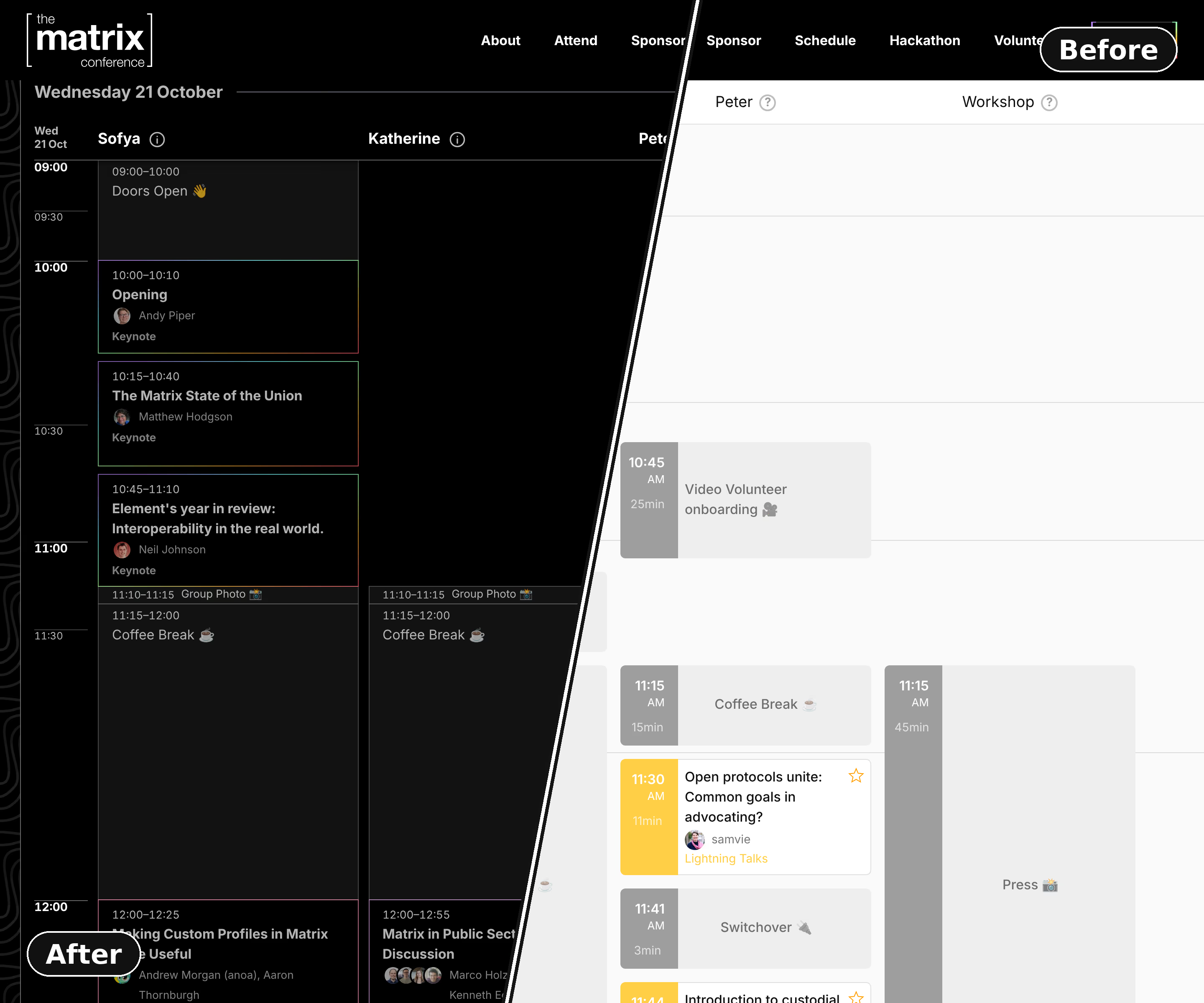
Another big change we did land in this timeframe has been the native schedule for The Matrix Conference website. This feature not only allowed us better visual integration into the conference page but also allows us to have new features which weren't possible before.
As a result we now have a new schedule which should be more accessible and bring more data sources together, we have the schedule also visible on the new live streaming page design (you'd have to catch it during the conference!) and last but not least we now have proper schedule widgets usable alongside the streams in rooms to support the remote conference experience.
🔗Other Changes to the Conference Website
Like with the matrix.org page here have been also a lot of smaller changes. Most prominently the team did an amazing job at ensuring the recordings were listed quickly as the conference ended, we overhauled both the livestream and the recordings page and we also improved our tooling around the recordings ingest to the page to reduce our turnaround times in the future.
🔗What Else Happened in the Working group?
Beyond the actual work on the websites, we also want to welcome xeni to the Working Group as our newest member who has joined us after helping us at The Matrix Conference 2026!
🔗If You Want to Contribute
If you want to contribute yourself to this feel free to check out both the website repository and the conference website repository or join us in our room at #matrix.org-website:matrix.org.
🔗Dept of Spec 📜
Andrew Morgan (anoa) {he/him} reports
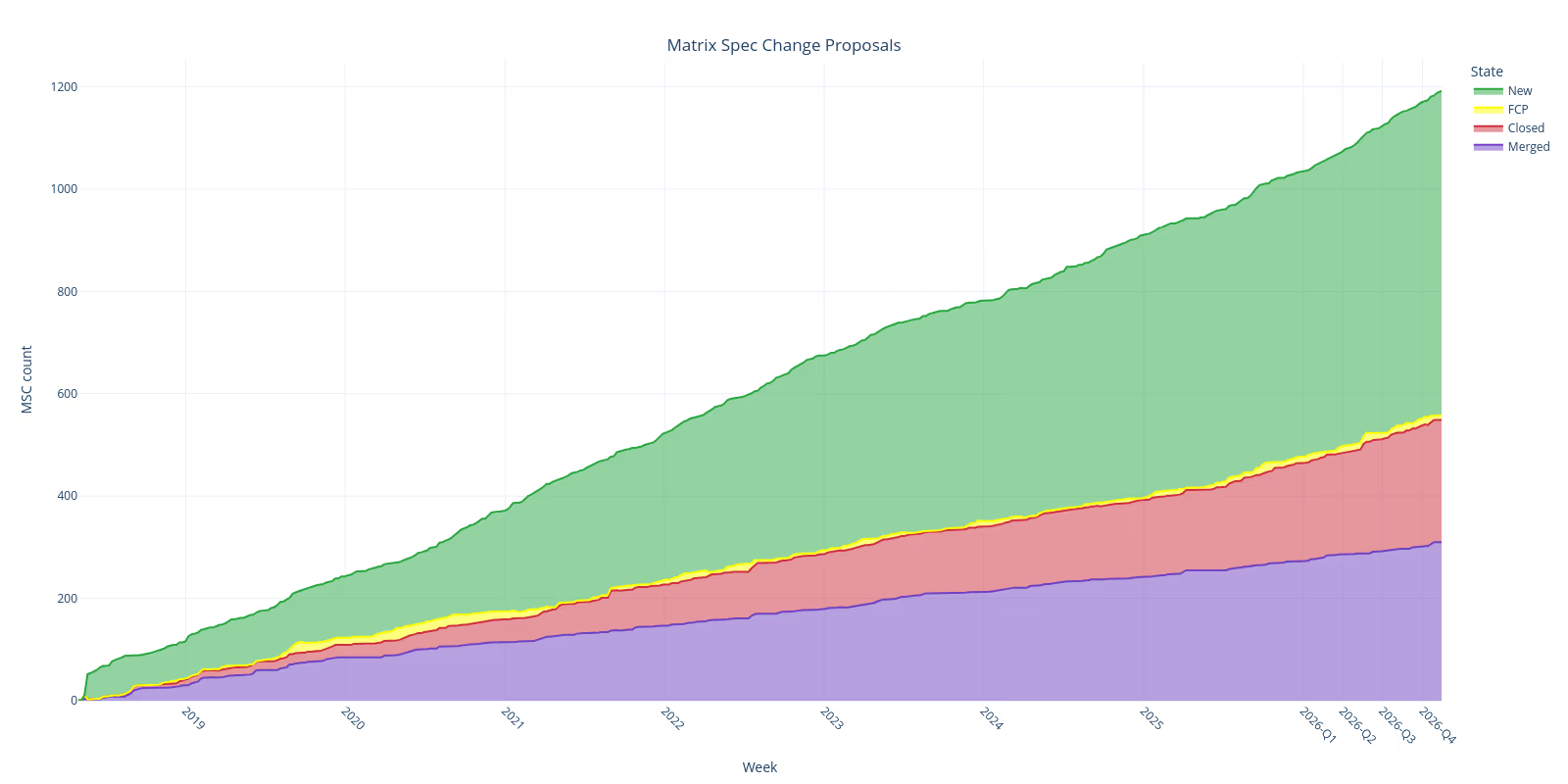
Here's your weekly spec update! The heart of Matrix is the specification - and this is modified by Matrix Spec Change (MSC) proposals. Learn more about how the process works at https://spec.matrix.org/proposals.
🔗MSC Status
New MSCs:
MSCs in Final Comment Period:
- MSC4492: Clarify that pagination tokens are directionless (merge)
- MSC4388: Secure out-of-band channel for sign in with QR (merge)
Accepted MSCs:
- No MSCs were accepted this week.
Closed MSCs:
- No MSCs were closed/rejected this week.
🔗Spec Updates
The Spec Core Team have been laser-focused on Matrix 2.0 work post-conference. We're hoping to get the 2.0 release out in the next few weeks.
Of the... 37(!) total MSCs marked
matrix-2.0on the matrix-spec-proposals repo, there are 3 MSCs that have yet to be accepted and 9 MSCs which need a spec PR written.Help is welcome, especially on the spec PR writing! A spec PR is the transformation from an MSC's free-form proposal text to the terse language of the Matrix spec (found in this repo).
On the MSC-acceptance side, MSC4576: Only allow data publishing when also allowing audio/video publishing on LiveKit transports is relatively uncontroversial, and likely just needs more eyes from the SCT.
The other two needs some more discussion, but they're close! Watch this space for the thrilling conclusion soon!
🔗Dept of Servers 🏢
🔗Zendrite (website)
pat-s reports
Zendrite, the Dendrite fork written in Go, released v3.9.0. This release brings faster remote room joins and a long list of newly supported MSCs.
Faster remote joins
- MSC3902: Zendrite now implements the joining side of faster remote room joins, where a server joins with partial room state.
- MSC3706: Zendrite also serves partial-state
send_joinresponses to other servers.- Joins to rooms with a malformed allow list are refused instead of answering 500.
send_joinandsend_leaveevents are no longer echoed back to their sender.Spec support
- MSC4155 invite filtering.
- MSC3881 remote toggling of push notifications, and MSC3890 removal of local notification settings when a device is deleted.
- MSC4429 profile updates in
/sync.- MSC2815, which gives moderators access to the content of redacted events.
- MSC3874 relation type and MSC2326 label event filters.
- MSC3930 poll and MSC4028 encrypted event push rules.
- MSC4446 moving the fully read marker backwards, MSC4502 targeted room member queries and MSC4491 invite reasons in
createRoom.- The room version
org.matrix.msc3389.10from MSC3389 is offered, and the unimplemented MSC4242 room version is no longer supported.Sliding sync
- Long polls no longer drain the database connection pool.
- The legacy MSC3575 implementation is removed, which fixes missed list room updates.
- Superseded requests stop quietly instead of logging foreign key violations.
Fixes
- Identical state events sent by another user no longer bypass the auth rules.
m.room.memberstate events now go through the membership flows.- Unreachable remote profiles answer 502 and the failure is cached.
Release notes: https://codefloe.com/pat-s/zendrite/releases/tag/v3.9.0
Chat: #dendrite:matrix.org
🔗Synapse (website)
Synapse is a Matrix homeserver implementation developed by Element.
madlittlemods (Eric Eastwood) says
This week we have a new release, Synapse 1.165.0. To highlight:
- We now have an initial, experimental implementation for efficient Server Announcements in Synapse. Server Announcements are for when an admin wants to message everyone on the server all at once (like announcing maintenance windows, policy changes, or incident notices), whereas the existing Service Notices are for admins to message people one by one (not efficient when you want to message everyone). There are still some rough edges that you can track in the epic, but it mostly just works for a client like Element Web.
- The media download endpoints now skip reading from disk for
HEADrequests so we can respond a lot quicker and avoid the unnecessary disk I/O (#20368, thanks to @JimKnoxx).- When using TLS
listenersfrom Synapse itself, we now let the OpenSSL defaults shine through, which allows connections to negotiate the use of the post-quantum hybridX25519MLKEM768key-exchange group when supported by your OpenSSL version (#20374, thanks to @bardiharborow).- Synapse now prefers the notary response that stays valid longest rather than whichever arrived last. This helps when we receive responses from multiple notary servers which could previously cause event verification to fail (#20406, thanks to @AyeshaWaseemAhmad).
Thank you to all our contributors for helping to make Synapse the best it can be. As always, feel free to stop by #synapse:matrix.org to join in on the discussion, and if you encounter a bug, make sure to report it.
🔗Dept of Clients 📱
🔗Tesseract (website)
Marco says
Hello friends, this is the monthly-ish Tesseract update!
Now in version 0.9.8, several nice matrix goodies have been added:
- Polls (creating, displaying, voting)
- Display live location shares.
- Message galleries (drag and drop more than one image/video/audio to the composer and they will be sent as a gallery)
- Forwarded messages display a clickable link to the original (per MSC4553).
- Display per-message profiles (per MSC4144).
Additionally, the login screen now has a 'find server' button that will show the user a list of available homeservers to pick from, fetched from https://joinmatrix.org.
On the UI side: configurable fonts, compact room list, pinned spaces sidebar, and timeline max width for wide screens.
Enjoy ;-)
🔗Sable (website)
F0rest reports
Hi TWIM! Sable here, just wanted to drop a quick note in here that we added support for MSC4495: Selective Presence, and we just released a blog post overview on how we are working on implementing Bundled URL Previews and adding new types of media to previews. Thanks!
🔗Robrix (website)
A high-performance, customizable client for power users. Its signature feature is a workspace layout with dockable tabs for chatting in many rooms and threads side by side. Written from scratch in Rust for all platforms.
Kevin Boos announces
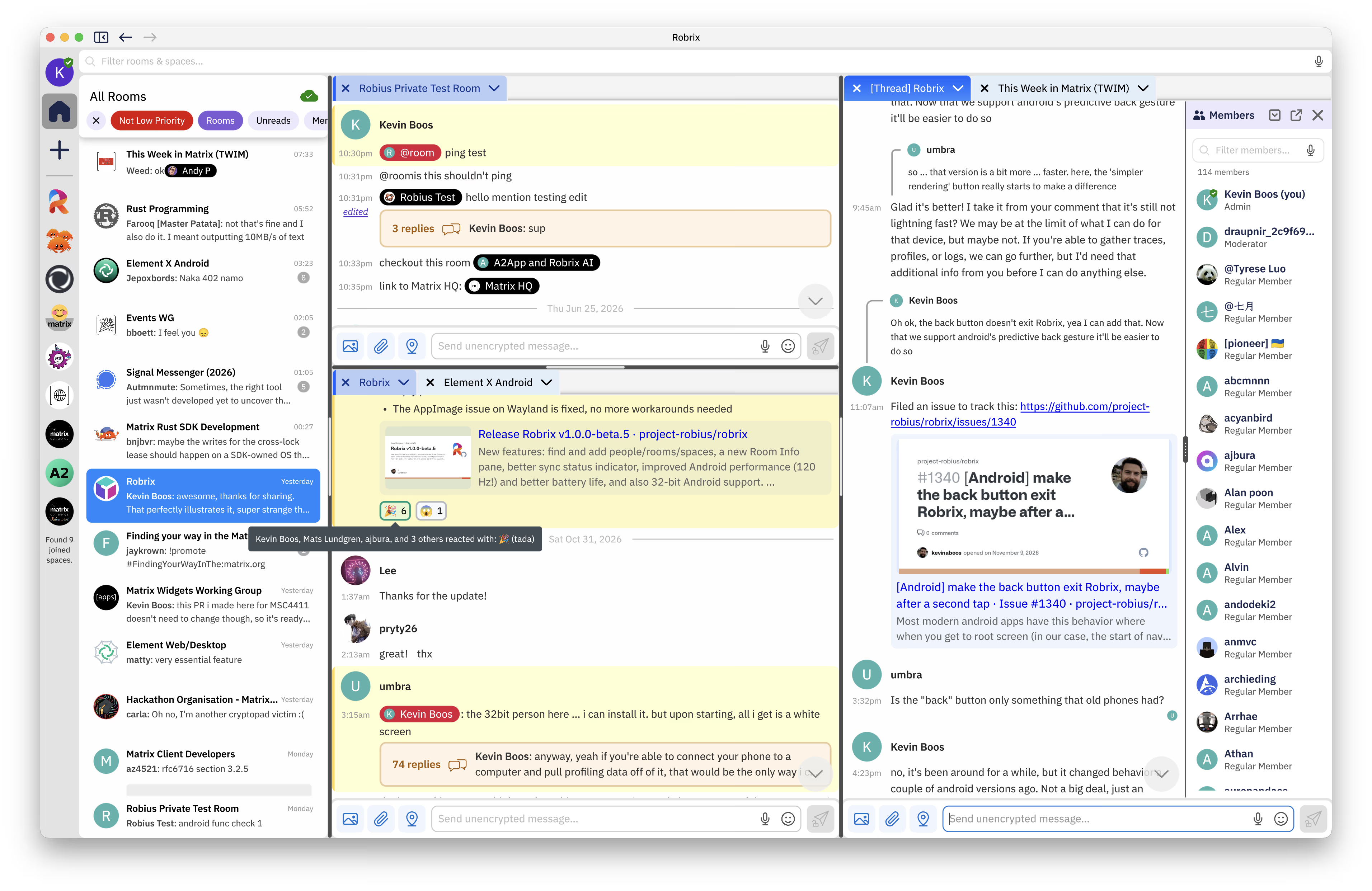
Hi everyone, I'm happy to share the first ever TWIM update for Robrix, our Matrix client that has been in development for over 3 years (oof, didn't realize it had been so long). Robrix runs natively on all major platforms and is written from scratch entirely in Rust, and we do mean from scratch ... we also wrote the whole underlying UI toolkit (Makepad) and the platform abstractions framework (Robius) from scratch in Rust. This gives us unique control over every aspect of the app, including how it integrates with the underlying OS and how its UI behaves and adapts.
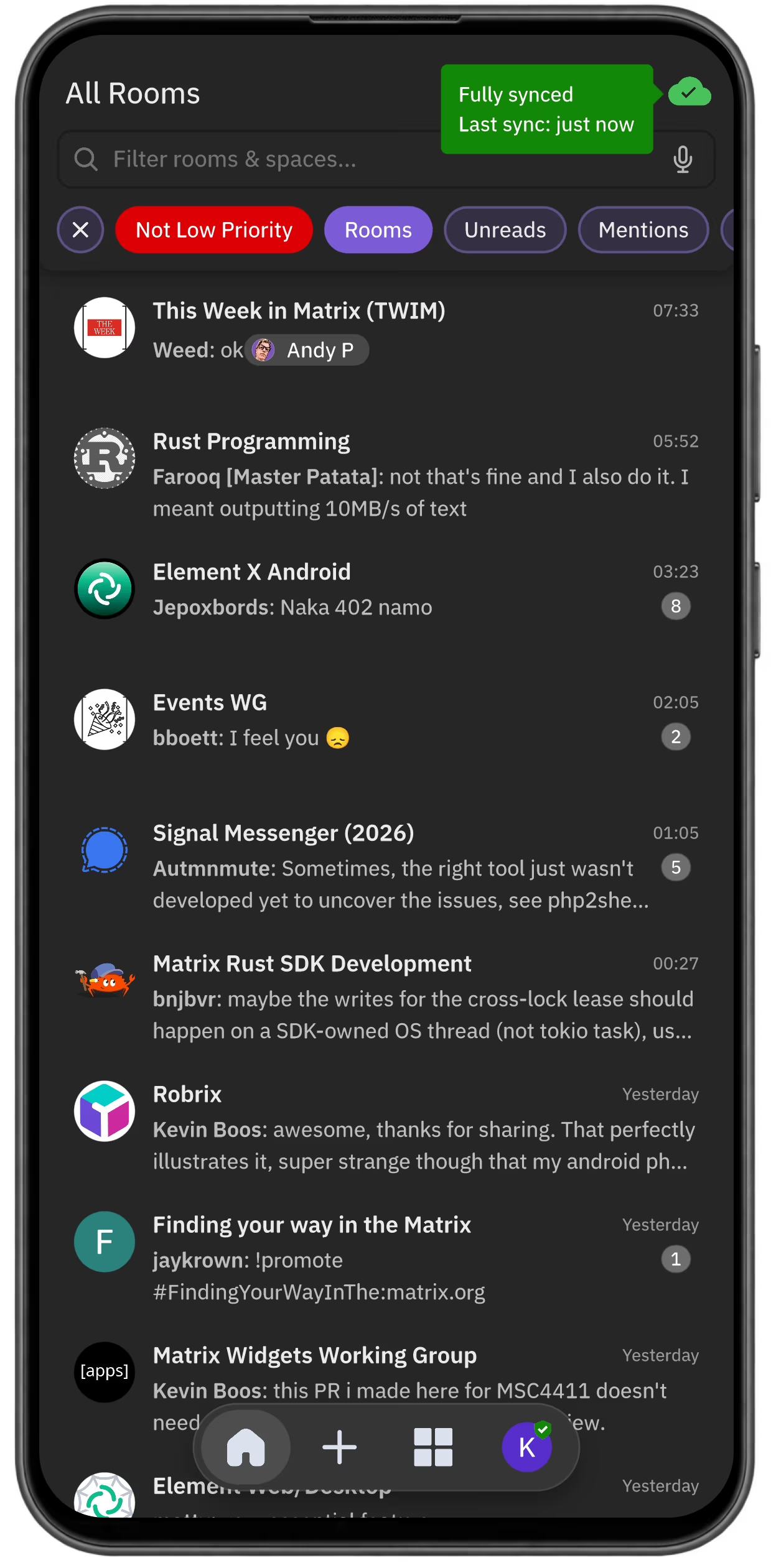
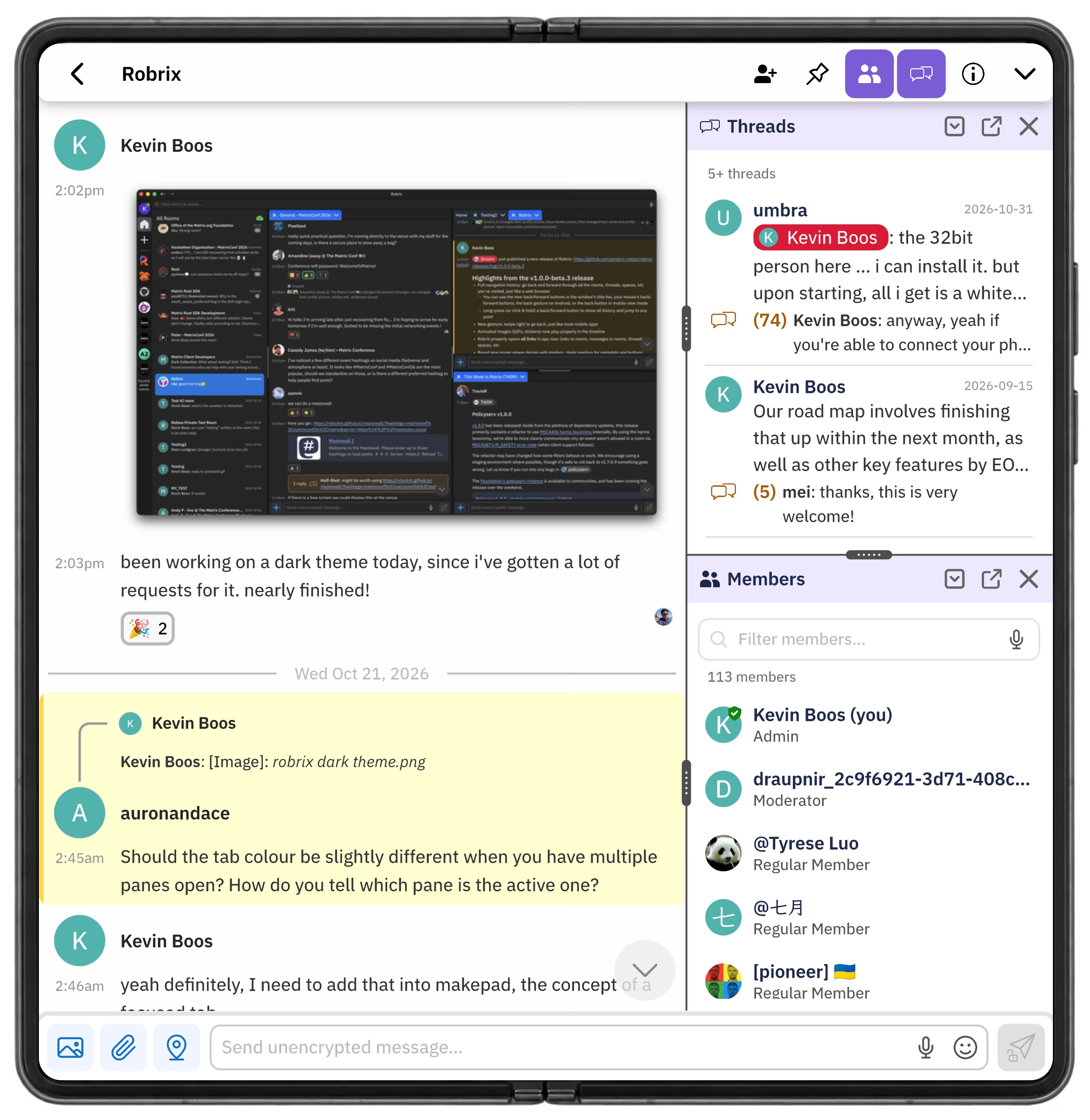
Robrix's goal is to be highly performant and efficient for power users, even under heavy use. Our signature "cool feature" is a multi-room dockable tabs layout (kinda like an IDE workspace), which lets you see and interact with as many rooms and threads as you want, all side-by-side. Each space gets its own dedicated layout too, so you can easily switch between custom room layouts on a per-space basis, instantaneously. We also have a neat multi-pane UI that lets you decide how extra room content is displayed, like pinned messages, threads, members list, room info, etc, even on mobile.
Robrix is also very intentional about letting you access any feature and any UI view on any device. So you can get the nice stacked mobile-like view on desktop, as well as the dockable workspace view on your phone or tablet. No limits! For example, you can zoom the UI to 112.8% if you want to, even on your iPhone.
I just got back from The Matrix Conference 2026 where I gave a talk about Robrix and some of our cool future directions, like custom generatable mini-apps that run right alongside your rooms or spaces, with a strict capability-like permissions model to ensure safety.
Since the conference, we've published two more beta releases, the latest one is available here. Some nice features we've added recently include:
- 🛡️ Moderator tools to report, mute, kick, or ban users, plus a powerful tool to find, select, and delete spam messages
- 🎨 Support for custom emoji and MXC URI media
- 😀 Quick reactions, double-tap to react, and a super fast emoji picker and search popup
- 🔍︎ Filter bubbles for the rooms list, like other clients but more flexible:
- You can inverse/negate a filter (e.g., "non-low priority rooms") by long-pressing or middle/right-clidking it
- We have more filters like "mod/admin rooms", and they can be combined in more ways
- 🚪 When leaving a space, we show a nice hierarchical view for choosing which rooms/subspaces to leave
- 📲 Tons of nice mobile-centric features: ↕️ auto-hide top & bottom bars when scrolling, and smoother/better virtual keyboard behavior
- 🤏 Lots of effort to make the UI perfect and space-efficient on narrower screens & windows
- 💬 Instantly discover and jump to old rooms (that have been tombstoned & replaced) with one tap
- Android: ⚡ consistent 120Hz smooth refresh rate while animating, which 🔋 auto-reduces when idle to preserve battery
- Plus support for 32-bit devices, Android 8+
- ⚙️ Tons of new settings to customize lots of Robrix's UI appearance and behavior
Kindly give Robrix a try, and let us know what you think by joining our Matrix room here: #robius-robrix:matrix.org. I'm adding new features (and taking requests!) all the time.
🔗Nexus (website)
Matrix client made with Flutter and a Gomuks backend.
QuadRadical reports
Hello TWIM! This week, Nexus v1.1.0 is out, with many new features, quickly followed by v1.1.1!
You can grab it from the release page. If you use the Flatpak repo, the nightly builds, or the NixOS module, just update.
Here's what changed in 1.1.0:
- Threads: You can now read and reply in message threads.
- Polls: Create polls, vote in them, and end them.
- Bot commands: Bots that advertise their commands using MSC4391 now get suggestions in the composer, along with a form for each command's options. Most of gomuks' built-in commands are supported too.
- Room directory: Browse and join public rooms, and publish your own rooms to the directory.
- Room upgrades: You can now upgrade a room to a newer room version, and rooms with a tombstone show a banner linking to the new room.
- Account switcher: You can now be signed in to more than one account and switch between them.
- Space improvements: You can now view a space's own timeline, and add or remove rooms from a space.
- Custom emoji and stickers: Send emoji and stickers from image packs, and manage your packs in settings.
- Reaction details: Hover over a reaction to see its shortcode, or open the new reactions popover to see who reacted with what.
- Locations: Shared locations are now shown in the timeline.
- Notification settings: Manage your push rules from inside Nexus, and set per-room notification levels from the room menu.
matrix:links: Nexus now opensmatrix:URIs.- Event diffs: Changes to power levels, join rules, server ACLs, pinned messages and other room state now show exactly what changed.
- Power level colours: Display names are now coloured by power level, with a setting to choose between per power level and per user colours.
- Power level groups: Related permissions are now grouped in room settings, so you can set them all at once, or expand a group to set each one individually.
- Weighted search: Emoji, user, room and settings search now put the best matches first.
- Performance and fixes: Lower memory use, and fixes for read receipts.
- And, as always, a whole lot of bug fixes 🙂
And in 1.1.1:
- New media players: Nexus has switched from media_kit to new video and audio players. Videos also no longer autoplay on desktop.
- Attachment previews: Attachments now show a preview in the composer before you send them.
- Banned members warning: Before you view a room's banned members for the first time, Nexus warns you that they may have offensive names or avatars.
- No more Play Services: The Android build was accidentally bundling Google Play Services through the location sharing library introduced in 1.1.0, thought it wasn't used at runtime. That's now fixed.
- Fixes for crashes when loading audio messages on the Flatpak, and failed audio messages are now handled gracefully.
🔗What's next?
I'll keep fixing bugs as you find them, and keep working through the features that are still missing. If you run into anything, please let me know in #nexus:federated.nexus.
🔗Get involved!
If you want to help with development, report bugs, ask questions, or simply keep up with new features, join our Matrix room at #Nexus Client (https://matrix.to/#/!bdbbTYhctZTWzoTzn9:federated.nexus), or check out the Git repo at https://nexus.federated.nexus.
🔗Commet (website)
Commet is a client for mobile and desktop with a modern UI and fun features!
airyz reports
We recently released versions 0.5.1 and 0.5.2 of Commet!
v0.5.1 was mostly focused on some improvements to voice chat, we added an on screen overlay showing activity in your current call (supported on windows, x11 and wayland), and added support for system audio capture when screen sharing on Windows. it also contains a bunch of other small improvements, and is more optimized to use less resources in the background.
v0.5.2 contains an important security fix, so please be sure to update as soon as you can if you are a commet user!
🔗Dept of VoIP 🤙
🔗LiveKit JWT service (website)
Bridging Matrix and LiveKit for Matrix RTC realtime sessions.
Johannes Marbach announces
lk-jwt-service 0.10.0 has been released and brings a bunch of important changes.
Most prominently, MSC4195 finally landed. 🎉 As a result, this release adds support for the stable Client-Server endpoints as per the merged version of the MSC. The unstable Client-Server endpoints and the legacy standalone endpoints remain supported in addition.
⚠️ IMPORTANT DEPRECATION NOTICES: Serving the Client-Server endpoints as per the MSC requires setting up lk-jwt-service as an application service on the homeserver. Since the MSC has been accepted, not running as an application service is deprecated as of this release and support for it will be removed in future versions. Details on how to configure the application service can be found in README.md. For the same reason, fronting more than one homeserver via
LIVEKIT_FULL_ACCESS_HOMESERVERSis deprecated as well and will be removed in future versions. This setting already only affects the legacy endpoints. For security reasons it is strongly recommended to only put the one homeserver that lk-jwt-service was set up as an application service for intoLIVEKIT_FULL_ACCESS_HOMESERVERS.A last-minute change in the MSC was to RECOMMEND granting publishing permissions to remote users. This acts as a fallback and allows users to join sessions even if their own homeserver doesn't provide an SFU. Server operators can granularly control whether to allow remote publishing with the new
LIVEKIT_REMOTE_CAN_PUBLISH_HOMESERVERSenvironment variable.A related change in the final MSC was to RECOMMEND disabling the permission to update one's own metadata for participants. The service now disables this permission by default on tokens. Admins that rely on this feature, may reenable the permission with the new
LIVEKIT_CAN_UPDATE_OWN_METADATAenvironment variable.MSC4196 also landed and to support the transition to its stable identifiers, the service now maps
m.call#ROOMslot IDs tom.call#room. This means clients will end up in the same LiveKit room regardless of which spelling they used.Finally, lk-jwt-service is now able to bind to a Unix socket via the
LIVEKIT_JWT_BINDenvironment variable. Thanks to GitHub user @cyberb for contributing this feature.
🔗Dept of Ops 🛠
🔗Connectivity Tester
MTRNord (they/them) announces
A homeserver report now covers more than basic federation reachability, so there are more choices about what to run and more detail to make sense of afterwards. Here are a few highlights from the latest release.
🔗Pick the Checks You Need
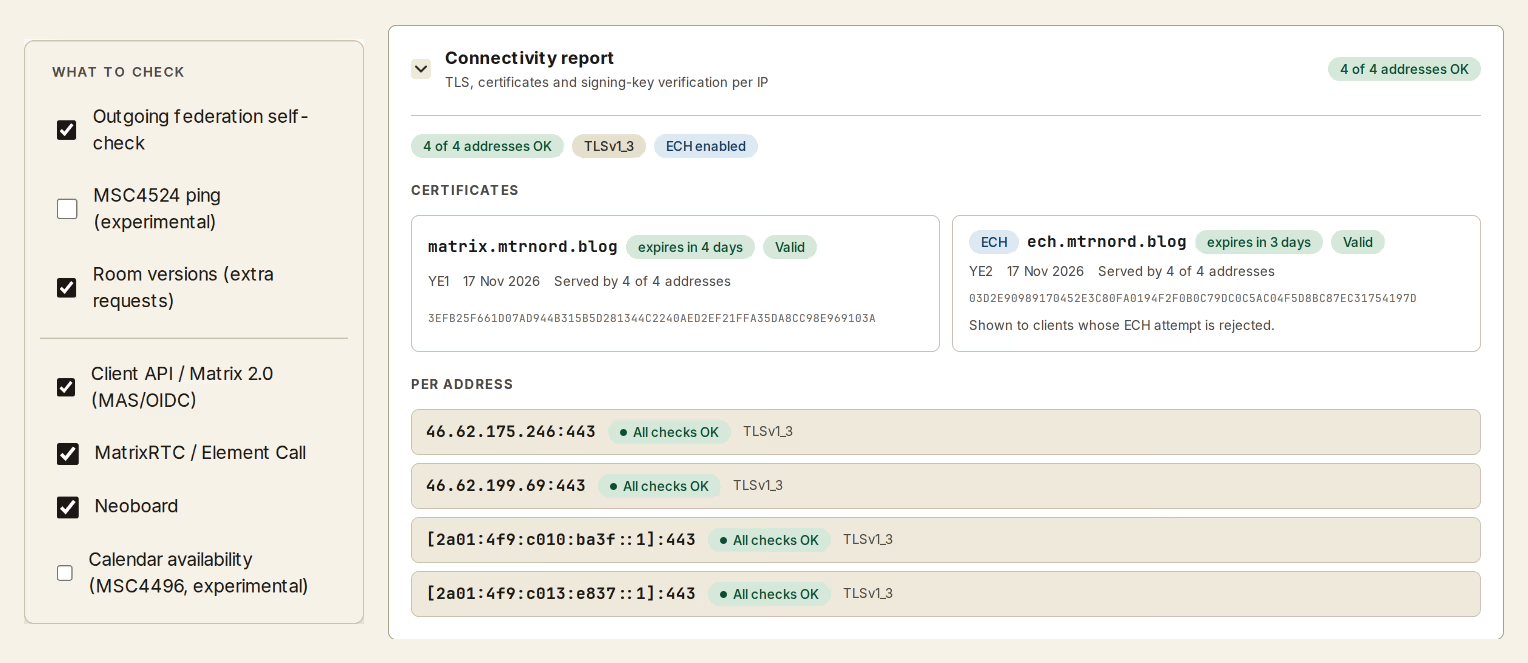
The homepage has a "What to check" picker. Outgoing federation, Client API / Matrix 2.0, MatrixRTC / Element Call, and Neoboard can be selected separately. The result then shows tabs for the categories you chose, instead of making you scroll through checks you did not run. Alerts and probe jobs also have federation-only, standard, and extended presets.
Some checks are useful when you need a closer look:
- The room-version check reports which Matrix room versions a homeserver accepts. It sends a signed synthetic federation invite for each version, so the picker labels it as making extra requests.
- The experimental MSC4496 calendar check looks for the client and federation availability endpoints. It only checks whether those routes exist; it does not request calendar data.
- The MatrixRTC results show whether the server advertises sticky events (MSC4354), which Neoboard's LiveKit mode and Element Call's Matrix 2.0 mode need.
🔗Read Connectivity Results More Easily
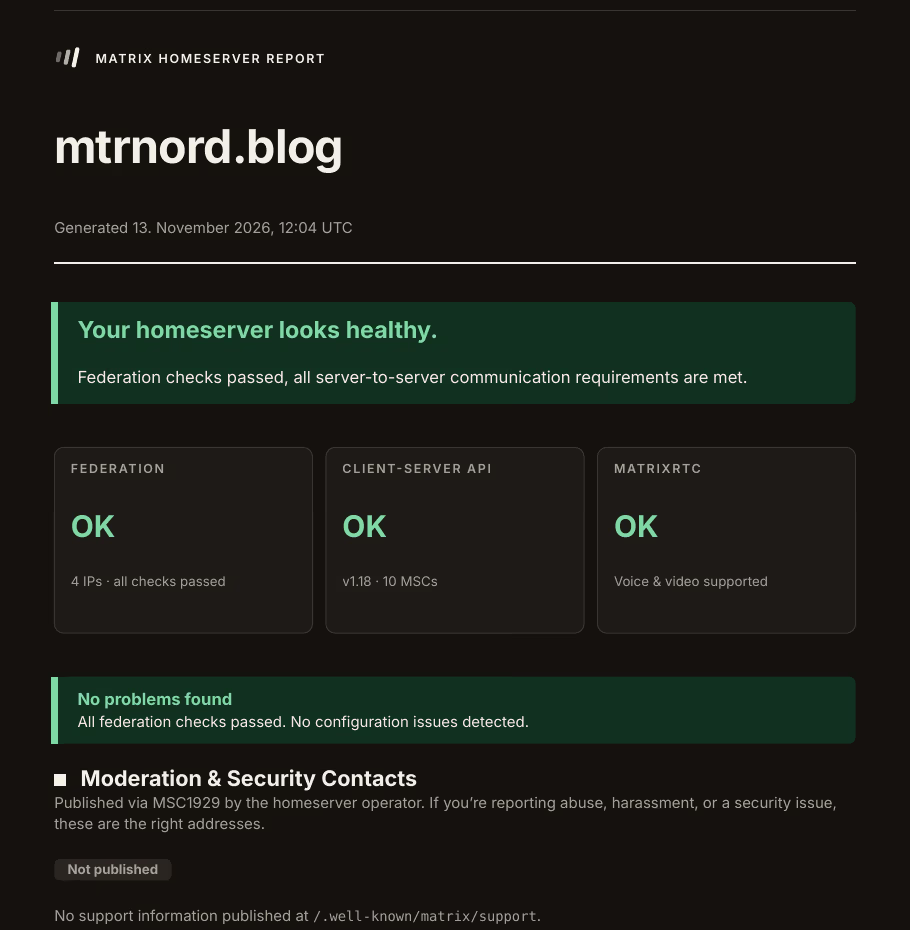
The results page opens with a health summary. When you scroll down, a slim bar keeps the server name and the main results in view. Section headers show useful status without opening them, and the connectivity section starts with the number of working addresses, TLS versions, and whether ECH is enabled.
Certificates are grouped instead of repeated for every IP, while each address has its own collapsible details. When a server advertises Encrypted Client Hello, the tester also verifies the public-name certificate a client sees if its ECH attempt is rejected. The report for
mtrnord.blogshows that certificate alongside the regular one.
🔗Alerts for Unsteady Connections and ECH
Alerts now confirm an outage from a window of recent checks: three failures in the last five checks by default. A single successful check during an unreliable spell therefore does not reset the whole confirmation. If a server keeps flipping between down and recovered, its status and history still update, but down/recovered emails and webhooks are suppressed while it is flapping. The recent checks and transitions are saved with the alert, so a restart does not reset that decision. The alerts overview also shows down and recovered changes live.
Outgoing federation checks also need strong evidence before they treat an address family as unsupported. Even when that result is cached, a background probe keeps checking for recovery. Alerts that have stayed down for more than a week are checked hourly, so recovery is still noticed without running a full check every minute.
ECH is covered by alert notifications too. For alerts with TLS expiry warnings enabled, the sooner expiring of the regular and ECH public-name certificates sets the warning date. If the ECH certificate expires first, the email and webhook name its public name. A replaced ECH certificate can also trigger the TLS certificate-change notification when that option is enabled.
🔗Share a Report
The actions are together in one place: get a permalink, re-run the check, or open the Export menu. Markdown now follows the report's sections, including the overview, problems, and individual checks. The redesigned PDF has a light theme for printing and a dark theme for screens, with a verdict banner and compact stat cards.
Try it at https://connectivity-tester.mtrnord.blog/. The changelog, source code, and support forum have more details and a place for feedback.
🔗Dept of Interesting Projects 🛰️
nex 🐾 says
While TWIM is usually full of impressive changelogs for huge projects, I wrote a quick blog post about how I hacked my homeserver to make it return a randomised biography in my profile, every time it was requested. You can read about it on my own blog: https://nexy.blog/2026/11/13/which-bio/. It's too big to embed here unfortunately, so you'll have to venture out into the world wide web to grab a read :^)
🔗Matrix Federation Stats 📊
Aine [etke.cc] reports
collected by MatrixRooms.info - an MRS instance by etke.cc
As of today,
20618Matrix federateable servers have been discovered by matrixrooms.info,4022(19.5%) of them are publishing their rooms directory over federation. The published directories contain20625rooms.The most popular server software among the online servers is:
- synapse:
15728(76.3%)- continuwuity:
2008(9.7%)- conduit:
500(2.4%)- dendrite:
256(1.2%)Stats timeline is available on 📊 MatrixRooms.info/stats
🧩 Integrations with apps and servers | 💜 Support the project | 👉 How to add your server | 🙅 How to remove your server
🔗Dept of Ping 🏓
Here we reveal, rank, and applaud the homeservers with the lowest ping, as measured by pingbot, a maubot that you can host on your own server.
Join #ping:maunium.net to experience the fun live, and to find out how to add YOUR server to the game.
| Rank | Hostname | Median MS |
|---|---|---|
| 1 | raccoon.cafe | 140 |
| 2 | kanp.ai | 184 |
| 3 | sspaeth.de | 188 |
| 4 | codestorm.net | 200 |
| 5 | nerdhouse.io | 210 |
| 6 | adventurers.nivdnd.club | 213.5 |
| 7 | usbpc.xyz | 214.5 |
| 8 | vibb.me | 240.5 |
| 9 | maunium.net | 291 |
| 10 | awesomesheep48.ca | 298 |
🔗That's all I know
See you next week, and be sure to stop by #twim:matrix.org with your updates!
To learn more about how to prepare an entry for TWIM check out the TWIM guide.
The Foundation needs you
The Matrix.org Foundation is a non-profit and only relies on donations to operate. Its core mission is to maintain the Matrix Specification, but it does much more than that.
It maintains the matrix.org homeserver and hosts several bridges for free. It fights for our collective rights to digital privacy and dignity.
Support us